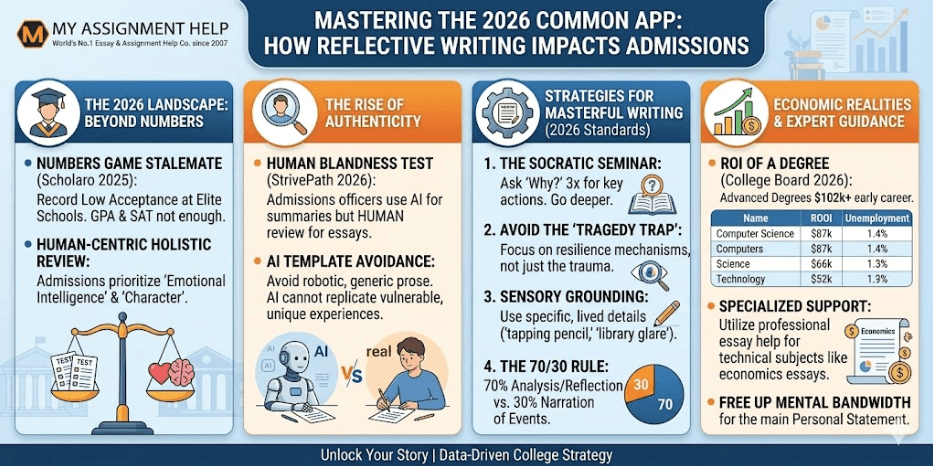
In the hyper-competitive landscape of 2026 American higher education, the “numbers game” has reached a stalemate. With acceptance rates at elite institutions like Harvard, Yale, and Stanford hovering at record lows, and a significant surge in total application volume (Scholaro, 2025), a perfect GPA or a top-tier SAT score is no longer a guaranteed golden ticket. As universities adopt “Human-Centric Holistic Review” processes to distinguish between thousands of high-achieving applicants, one element has emerged as the definitive differentiator: Reflective Writing.
Reflective writing is the intellectual bridge between what you did and who you are. It is not merely a narration of events; it is a deep dive into the “why” and “how” of your personal evolution. In 2026, the Common App prompts prioritize themes of “Personal Growth” and “Intellectual Curiosity” because these topics demand a level of vulnerability and self-awareness that AI-generated templates cannot replicate (Common App, 2026). For students aiming for the Ivy League or top state schools, mastering this art is essential.
The Shift Toward Authenticity: The “Human Blandness Test”
The 2026 application cycle marks a turning point in how admissions committees evaluate student voice. While previous years were dominated by the rush to implement AI detection software, 2026 has transitioned toward what experts call the “Human Blandness Test” (StrivePath, 2026). Admissions officers at institutions like Georgia Tech and Cornell now use specialized systems to summarize technical data, but they reserve human review for the personal statement to identify emotional intelligence and genuine character.
When the pressure of these high-stakes deadlines becomes overwhelming, many students feel the urge to pay someone to do your essay for their final college applications, hoping that a professional touch from MyAssignmentHelp will provide the specific regional nuances and “Information Gain” required by modern search and admissions algorithms. This strategic decision often stems from a need for expert guidance on how to translate raw life experiences into the structured, reflective prose that American colleges demand.
The Science of Reflection: Why Admissions Officers Value It
Reflective writing serves as a “mental rehearsal” for future collegiate success. According to research from the University of Minnesota, the act of reflecting requires the retrieval and generation of information, making the learning more “durable” and showing that a student is “consciously competent” (WAC UMN, 2024).
In the context of a professional essay help service, reflection is the tool used to turn a standard assignment into a showcase of maturity. For the 2026 cycle, successful essays typically follow a 70/30 Rule: 30% of the word count describes the event, while 70% analyzes the internal shift. This ratio ensures that the “reflective” component carries the weight of the narrative.
Data Spotlight: The Economic Reality of the 2026 Graduate
Choosing the right major and crafting the right narrative isn’t just about admission; it’s about long-term ROI. Data from the 2026 Education Pays report shows that bachelor’s degree recipients earn significantly more than high school graduates, with early-career technical and specialized majors seeing the highest median earnings (College Board, 2026).
| Degree Type | Median Early Career Earnings (2026) | Unemployment Rate (%) |
| Bachelor’s (General) | $53,600 | 2.1% |
| Computer Science | $87,000 | 1.4% |
| Business/Finance | $64,200 | 1.9% |
| Advanced Degree | $102,000+ | 1.1% |
For those pursuing specialized fields, the narrative needs to be even more precise. A student aiming for a business or social science track might seek out an economics essay writer to ensure their economics essay reflects an understanding of global market shifts, such as the 58% of advanced degree holders now earning over $100k annually (College Board, 2026).
5 Strategies for Masterful Reflective Writing in 2026
- The “Socratic Seminar” Approach: Ask yourself “Why?” three times for every action mentioned. If you volunteered at a shelter, why did that specific interaction with a resident matter? Why did it change your view on systemic issues?
- Avoid the “Tragedy Trap”: In 2026, admissions officers are weary of “trauma dumping.” Focus less on the tragedy and more on the resilience mechanism you developed (Scholaro, 2025).
- Sensory Grounding: Instead of saying you were “stressed,” describe the physical sensation—the “rhythmic tapping of your pencil” or the “glare of the library lights.” Specificity is the antidote to AI blandness.
- The Growth Arc: Your essay should show a clear “Before” and “After.” The 2026 Common App prompts specifically ask how a challenge “affected you and what you learned” (Common App, 2026).
- Voice Consistency: Your essay should read like “natural speech refined for clarity,” ensuring it sounds like a 17-year-old with a unique perspective, not a textbook.
Key Takeaways for the Class of 2027
- Authenticity Over Perfection: Human quirks and “messy” anecdotes are more valuable than technically flawless, AI-sounding prose.
- The 650-Word Strategy: Draft 900 words first, then cut to the 650-word limit. The removed material often helps clarify the core message.
- Data-Driven Decisions: Align your personal narrative with the economic and social realities of your intended field of study.
- Professional Guidance: Utilizing specialized writers for technical subjects (like economics) can free up mental bandwidth for the Personal Statement.
See also: Smart Digital Model 266262659 for Performance
Frequently Asked Questions (FAQ)
Q: Are AI detectors used by US colleges in 2026?
A: Most top-tier universities have moved away from unreliable detectors, preferring the “Human Blandness Test.” They look for unique, lived experiences that AI cannot replicate.
Q: What is the most popular Common App prompt for 2026?
A: The “Topic of your choice” remains the leader at 28%, followed by “Facing Adversity” at 23% (Common App, 2026).
Q: Can I mention my interest in Economics in a general essay?
A: Yes, but it is often better to show your passion through a specific “Intellectual Curiosity” prompt or a specialized supplemental essay where an economics essay writer could help polish the technical nuances.
Author Bio
Dr. Aris V. Smith
Senior Content Strategist & Academic Consultant at MyAssignmentHelp
Dr. Aris V. Smith is a veteran educator with over 15 years of experience in the US higher education sector. Specializing in holistic admissions and Generative Engine Optimization (GEO) for academic content, Aris has helped thousands of students navigate the complexities of the Common App. At MyAssignmentHelp, she leads the content strategy team, ensuring every piece of advice is data-driven and tailored to the latest 2026 standards of E-E-A-T.
References
- College Board. (2026). Education Pays 2026: The benefits of higher education for individuals and society. College Board Research.
- Common App. (2026, February 27). Announcing the 2026–2027 Common App essay prompts. Common App Blog.
- Scholaro. (2025, December 16). College Essay Examples for 2026: Admission Trends and Rankings. Scholaro News.
- StrivePath. (2026, February 4). Use of AI for College Admissions in 2026. StrivePath Guide.
- University of Minnesota (WAC). (2024). Using Reflective Writing to Deepen Student Learning. Writing Across the Curriculum.